
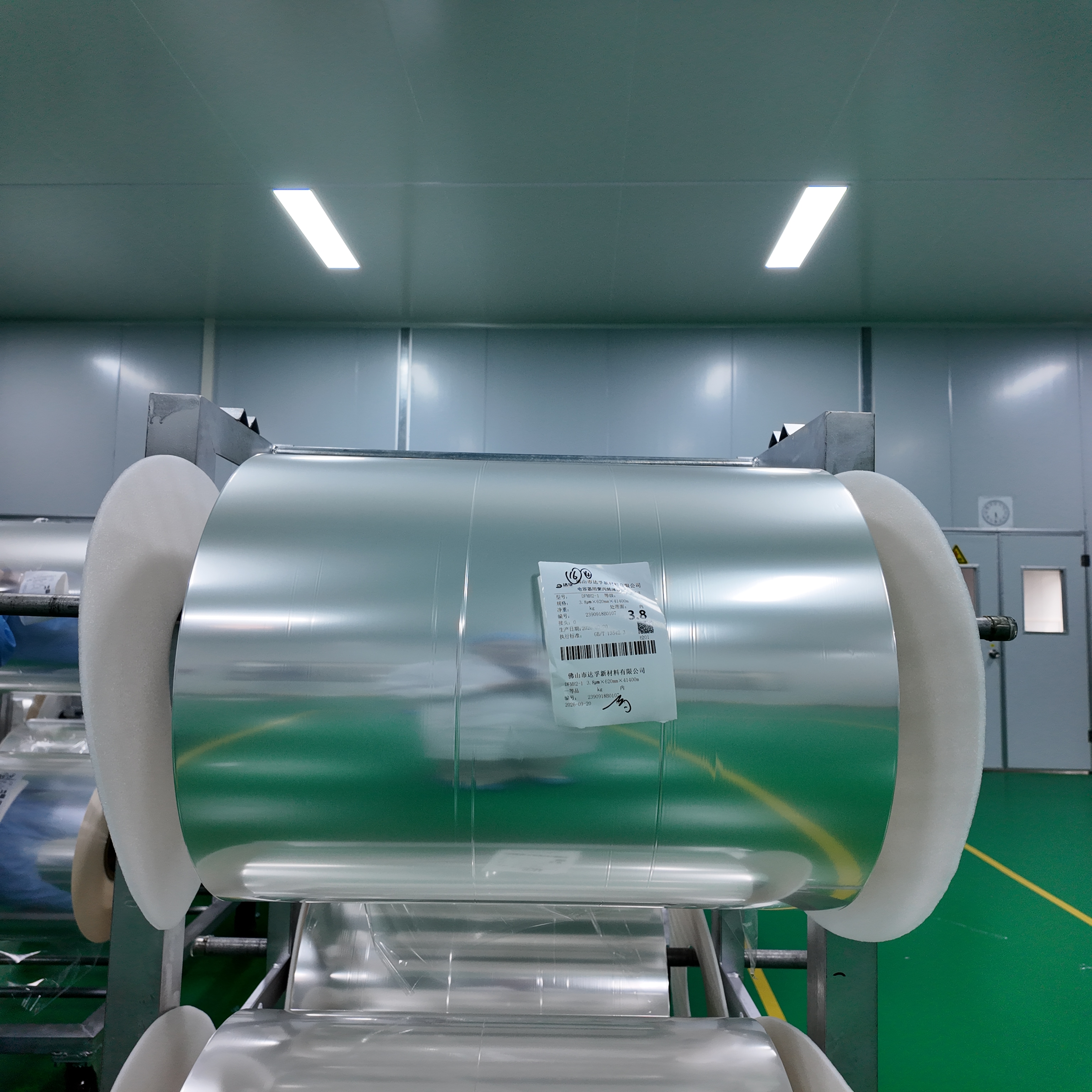
BOPP Capacitor Film is a material starting point when a capacitor design needs a thin polypropylene dielectric. The finished component still needs a defined capacitance requirement under its intended electrical conditions. A low-signal reading taken without operating DC voltage does not answer every question about an energized component, and a reference dielectric constant for raw film cannot establish the complete wound capacitor's behavior.
Dafu's engineering film range lists ultra-thin BOPP capacitor film with an overall thickness range of 2–8 μm and grade-specific thermal limits. Its technical information includes laboratory reference data for a particular film specimen. It does not publish a DC-bias capacitance curve for every wound design or a finished-component tolerance derived solely from the incoming film grade.
Define what the circuit requires
State whether the design needs a nominal capacitance at a specified measurement condition, an operating capacitance range, or retained capacitance after an electrical endurance exposure. These are distinct requirements. A component can be measured at several points in its life, and the result needs to identify which question the measurement answers.
Record the operating DC voltage and any superimposed alternating component within the responsible circuit team's specification. Temperature, duty and component construction also belong in that brief. The film supplier can review material selection, while the capacitor manufacturer must assess the complete electrical requirement for the actual element.
Do not assign a voltage-dependent correction curve from a different dielectric technology to the polypropylene design. Equally, do not promise that the finished element has no relevant change under any electrical condition. Use measurements or component data for the identified construction instead of assuming an answer from a broad capacitor category.
Separate dielectric properties from element geometry
Capacitance depends on dielectric properties and the electrode arrangement, including effective area and separation. Raw-film data describe only part of this system. Winding, margins, metallization pattern and the final element geometry determine how the supplied film becomes a working capacitor.
Identify the film grade and gauge alongside the winding specification. A comparison between two finished elements is difficult to interpret if their effective electrode area or construction differs. A material change should be assessed with those design differences visible rather than treated as the only possible reason for a capacitance difference.
The brochure's laboratory specimen is not identified as a complete capacitor construction. Its reference electrical values should remain in that scope. They can support discussion of the dielectric material, but should not be converted into a guaranteed operating capacitance, rated voltage or tolerance for an undisclosed wound element.
Describe the measurement condition completely
For each capacitance result, record the instrument method, measurement frequency, signal amplitude, temperature and whether a DC bias was present. Also identify the equivalent-circuit model used by the instrument where relevant. A bare number in microfarads is not enough to compare two laboratories or two test stages reliably.
If biased measurement is required, use equipment and a procedure suitable for the voltage and component. The responsible electrical laboratory should establish the arrangement, stabilization and handling method. This article does not prescribe a universal test voltage or suggest applying high voltage through an instrument that is not designed for that purpose.
Keep the measurement temperature controlled and recorded. An energized component can have a different thermal condition from an unpowered bench sample. If the objective is to isolate electrical bias, the trial must avoid confusing a temperature difference with the variable being investigated.
Distinguish an operating observation from permanent loss
A reading under operating bias and a reading after the bias has been removed describe different states. Define when each measurement is made and what conditioning precedes it. Without that sequence, a report may combine a reversible observation with a retained change and give them the same label.
Establish a baseline for each test object before exposure. Where the program includes post-stress comparison, return to the agreed reference measurement condition before judging retained change. State any recovery interval used. The aim is to make comparisons reproducible, not select whichever time produces the smallest difference.
If capacitance remains lower after exposure, investigate the component rather than immediately describing the effect as an intrinsic DC-bias property of BOPP. Electrode condition, electrical events, connection integrity and processing history may require review. The actual construction and failure evidence should guide the investigation.
Connect self-healing observations to the right question
A metallized film capacitor may be designed around self-healing behavior, but the raw BOPP film does not specify the finished electrode system. Where electrical events are part of the investigation, review the metallization, segmentation and applied stress with the component designer. Do not infer an acceptable amount of capacitance loss from the polymer name.
Keep any event monitoring and final capacitance reading connected to the same component identity. An unexplained final shift may need more information than a single before-and-after number. Conversely, a detected event does not alone establish the cause of every change unless the relevant evidence supports that relationship.
Define acceptance against the circuit's required operating range and the component's qualification plan. A stable average across a group should not hide individual components outside that range. Record the spread and relevant construction details so purchasing can distinguish a controlled material comparison from unrelated manufacturing variation.
Give the film inquiry a useful boundary
Send Dafu the intended gauge, grade direction, slit format and thermal duty, together with the capacitor application. Discuss the incoming properties that require control, while keeping the wound design and biased-measurement procedure with the responsible component team. This division produces a more actionable material request than asking for a film that guarantees a finished capacitance.
The final selection should combine traceable BOPP film specifications with evidence from the identified capacitor. Keep nominal capacitance, operating measurement and post-stress retention as separate entries in the approval record. That allows a buyer to understand what has actually been demonstrated and prevents a favorable raw-film value or an unbiased bench reading from becoming an unsupported guarantee for an energized circuit.