
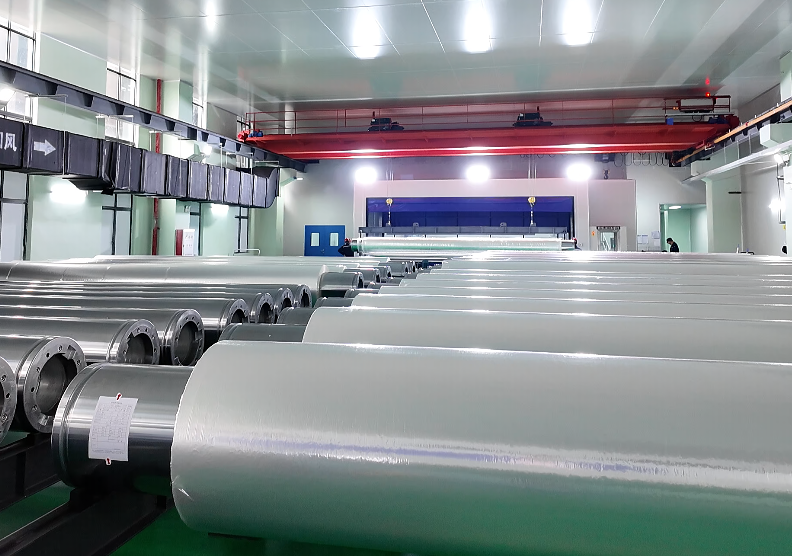
BOPP Capacitor Film supplies the dielectric substrate for a capacitor design, but its raw-film dielectric strength does not establish the partial-discharge behavior of the wound component. Local electrical activity can depend on the assembled insulation geometry and manufacturing condition. A buyer investigating unexpected discharge should therefore examine both the incoming film and the process that turns it into an element.
Dafu's engineering film range lists ultra-thin BOPP capacitor film across an overall 2–8 μm range, with temperature and thickness limits that vary by grade. The product page also provides laboratory reference results for a 3.8 μm specimen whose grade is not identified. Those results support a material comparison within their stated scope. They are neither a finished capacitor voltage rating nor a partial-discharge acceptance limit.
Understand the question asked by each test
A breakdown test identifies failure under its specified electrical and specimen conditions. Partial-discharge assessment looks for localized discharge activity that does not initially bridge the complete insulation system. These observations are related to insulation performance, but one cannot be calculated reliably from a catalogue breakdown number alone.
The distinction matters when a component remains functional while an electrical test detects activity. Treating that result as equivalent to immediate full breakdown can misdirect the investigation. Ignoring it because the film's reference dielectric strength is high is equally unhelpful. The capacitor design team must define what the activity means for the intended component and duty.
At the material purchasing stage, ask which incoming properties are controlled and which component tests will be performed after conversion. This assigns responsibility without implying that a raw-film supplier can approve an undisclosed winding, electrode pattern or termination arrangement.
Identify the construction being evaluated
Record the selected film grade, gauge, electrode system, margins and winding configuration. Include the intended dry or impregnated construction, where applicable. A change in any of these can create a different test object even when the polymer name remains BOPP.
Pay particular attention to interfaces and locations where gas gaps, contamination or irregular geometry may occur. These are investigative candidates, not proof of a defect in the supplied film. An element inspection should examine the actual build before assigning a cause from an electrical trace alone.
Compare suspect components with retained incoming material and with components made under a known stable process. Where possible, hold the film lot constant while examining a specific manufacturing change. This provides stronger evidence than comparing unrelated finished parts that differ in material, winding and encapsulation simultaneously.
Define the electrical procedure before comparing results
The report should identify applied waveform, voltage sequence, frequency, temperature, measurement arrangement and the criterion used to recognize activity. Record the background signal before assessing the component. Without an understood noise level, a low reported reading may describe the setup's limitations rather than the insulation's behavior.
If inception and extinction voltages are required, define the observation procedure for both increasing and decreasing voltage. Do not treat a first detected pulse as a universal material constant. The agreed test route and the component's previous electrical and thermal history belong with the result.
Calibration and noise discrimination should be handled by the responsible high-voltage laboratory. The purpose of a purchasing article is to identify the evidence needed, not to prescribe a universal test voltage. Different capacitor constructions and application requirements may call for different acceptance methods.
Trace changes through winding and finishing
Inspect the sequence from slitting through electrode preparation, winding, consolidation and final processing. A stage-by-stage comparison can show when the electrical behavior changes. Retain samples or process records at useful boundaries so an unexpected result does not require reconstructing the entire history from memory.
Winding consistency deserves review because the dielectric must function in the geometry actually produced. Examine tension records, alignment and the condition of edges without assuming that increasing tension is a cure. A process adjustment can alter several features at once, so evaluate its effects on the complete component.
If activity appears only after a finishing operation, compare components before and after that operation under an agreed procedure. The investigation may involve mechanical movement, material contact or the final insulation environment. Replacing the incoming film immediately can hide the stage that needs correction and make the original problem difficult to reproduce.
Keep thermal selection separate from discharge evidence
Choose the film grade for the intended service conditions using its own thickness and temperature range. Do not combine the highest listed temperature with the thinnest gauge unless that combination is actually offered. Likewise, a laboratory result on one reference thickness should not be assigned to all gauges.
The thermal condition during component testing should be identified independently. A room-temperature observation cannot establish behavior throughout the complete operating envelope. Where temperature-dependent testing is part of the qualification plan, compare components after consistent conditioning and record the relevant component temperature.
This prevents two common misunderstandings: promoting a film's service-temperature description into a full component approval, and treating one favorable electrical test as evidence for every thermal condition. The final acceptance belongs to the defined capacitor construction and its required duty.
For terminology, OMICRON’s introduction to partial-discharge testing provides background on localized insulation activity. Such general guidance helps frame the investigation; it does not supply an acceptance limit for this BOPP grade or for a capacitor that has not yet been built and tested.
For an effective sample inquiry, provide the supplier with the requested gauge, grade direction, slit format and application, while keeping the component laboratory responsible for the discharge criteria. Share a structured failure description if an investigation is underway: when activity appears, which builds are affected and which stages have been compared. BOPP capacitor film should be selected using credible incoming data, then validated through the wound element. That division makes both the material assessment and the component qualification more useful.