
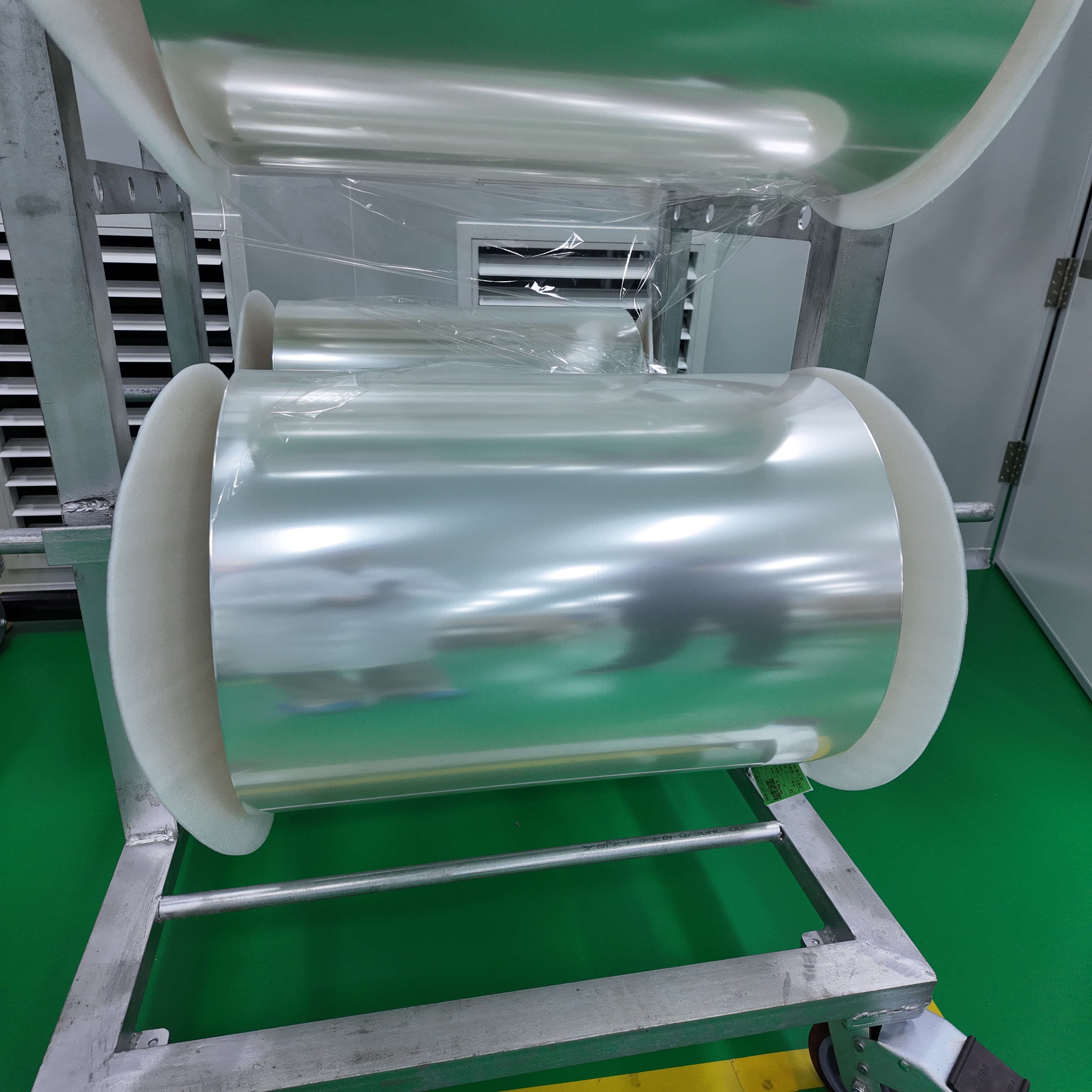
BOPP capacitor film is often requested against a target voltage, but a dielectric-strength result for raw film is not a finished capacitor's rated voltage. The film test, wound construction and service waveform describe different levels of the design. A buyer who multiplies one laboratory strength value by nominal gauge can arrive at a number that does not represent the operating capability of the capacitor.
Dafu, an engineering plastic film manufacturer, lists DFMG, DFMH, DFMS and DFMU within its ultra-thin BOPP capacitor-film range. The grades have their own thickness ranges and service-temperature limits. Choose an identified grade for the material review and keep those limits separate from the voltage rating established by the capacitor manufacturer for a qualified element and finished product.
Define what voltage the customer means
A request may concern steady DC operation, an AC waveform, repeated pulses or a short proof test. These conditions should not be represented by the same unlabeled voltage number. Identify the operating waveform, relevant peaks, frequency content and duration. Also state whether the requirement applies continuously or only during an agreed test. This gives the film supplier a meaningful application context without asking it to assign the capacitor's rating.
Include the temperature at the dielectric during service, not just the room temperature near the equipment. Electrical loading and cooling can affect the element's operating condition. A design discussed only in terms of ambient temperature and a nominal supply voltage leaves important inputs unresolved. The material and capacitor teams should agree which conditions drive qualification before screening the gauge.
Understand the raw-film result
Dielectric strength expresses a measured breakdown outcome in relation to specimen thickness under the stated method. Its interpretation requires specimen preparation, electrical exposure and the applicable grade or sample identity. It is a material test result, not a recommendation to operate continuously at that field. If a datasheet reports reference measurements rather than guaranteed specifications, preserve that distinction in the material discussion.
The Dafu product information identifies reference laboratory data and explicitly separates raw-film dielectric testing from finished-capacitor rating. Ask for evidence applicable to the grade and gauge being considered. Do not assign measurements from an unidentified reference sample to every grade in the range. A complete material specification should say what is controlled for supply and what remains supporting laboratory information.
Winding introduces a different electrical construction
The capacitor includes electrode patterns, dielectric layers, margins and end connections. Their geometry determines where electrical stress is applied and where local conditions differ from the broad film specimen. Changes in layer arrangement or electrode segmentation belong to the capacitor design. The presence of the same BOPP polymer does not make two wound elements electrically equivalent.
Identify the intended film gauge and its tolerance together with the winding and metallization construction. Keep the actual measured material connected to the element samples. A nominal gauge on a purchase order cannot describe a locally damaged area or every feature introduced during conversion. Material consistency is important, but the capacitor maker must also control the processes that turn the film into the electrical component.
Do not substitute a proof test for a life requirement
A brief voltage test can detect certain weaknesses under its chosen conditions. It does not reproduce every form of sustained or repeated electrical exposure in service. Define the purpose of the test and retain its waveform, temperature and duration. A passed proof test should be reported as that result, not converted into an unsupported continuous rating or a predicted lifetime.
The customer should establish the endurance and application tests for the completed capacitor. Material data help narrow the candidates, while the design tests evaluate the combined construction. If a higher operating voltage is proposed, review the relevant qualification rather than assuming that an earlier test with spare margin approves the change. The same caution applies when reducing gauge to increase capacitance within a fixed volume.
Use grade-specific thermal limits in screening
The range contains grades intended for different service temperatures, so one temperature statement cannot describe all of them. Match the chosen grade with the element's intended operating condition. A higher-temperature category should not be treated as automatically providing a higher voltage rating. Thermal capability and electrical qualification are related considerations, but they are not interchangeable labels.
Consider the temperature route during conversion as well as during operation. Winding, subsequent element processing and the finished assembly can expose the dielectric to different histories. Record those histories when comparing grades. If electrical results change after a particular process step, investigate that step with identified material rather than selecting a new rated-voltage number for the raw film.
Investigate the part of the rating that limits the design
If the capacitor cannot meet the intended application, determine whether the controlling issue is breakdown, heating, insulation at an edge, capacitance stability or another defined failure criterion. These observations lead to different design and material discussions. Raising the film's headline dielectric strength may not resolve a limitation at an electrode boundary or connection. Use the failed element and its test record to locate the relevant mechanism.
Keep raw-film comparisons controlled while the capacitor team reviews design changes. A different gauge, electrode pattern and winding setting introduced together make the material contribution difficult to identify. Screening should allow each candidate's role to be understood, then qualification should cover the selected combined construction. This approach connects supplier evidence to the design without presenting a material result as finished-product approval.
Send an application specification with the sample request
For Dafu to review BOPP film candidates, provide the capacitor type, waveform, target operating voltage and relevant proof and endurance requirements. Include the expected dielectric temperature, proposed gauge, electrode construction and converting history. Ask for grade-specific supply and test information against those conditions. The resulting film shortlist supports the capacitor manufacturer's rating process; it does not replace that process with a thickness calculation.