
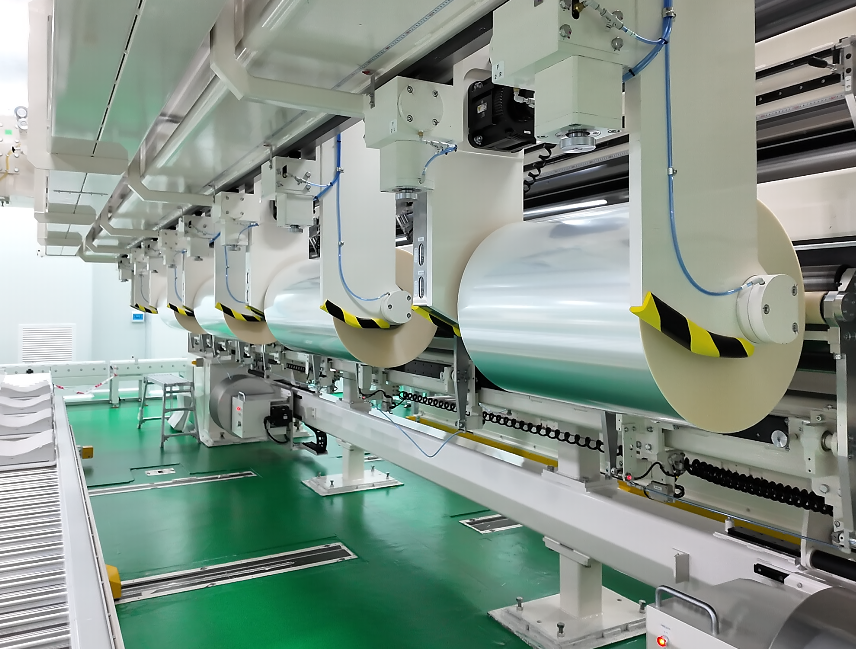
BOPP Capacitor Film is only one part of a metallized capacitor's self-healing design. A high dielectric-strength result on the incoming film does not establish how a completed element clears a local electrical fault, how much capacitance it loses or whether it remains suitable after repeated events. These questions belong to the electrode and component construction as well as the dielectric.
Dafu's engineering film range offers ultra-thin BOPP dielectric film with grade-specific thickness and service-temperature ranges. The product page distinguishes commercial grades from a separate laboratory sample whose grade is not identified. That distinction is essential when planning self-healing evaluation: neither a family description nor a laboratory breakdown result should be promoted into a finished-capacitor rating.
Define the behavior expected after a local fault
In a metallized-film construction, a localized event may clear electrode material around a defect and isolate the affected region. Whether that process is controlled depends on the construction and operating conditions. The word self-healing should therefore refer to an observed component behavior, rather than a guarantee that any dielectric puncture can be tolerated without consequence.
The component designer should specify the required outcome after an event. Relevant questions include retained insulation, acceptable capacitance change and the absence of continuing damage. Those criteria differ from a simple pass or fail on a virgin film strip. The test plan needs to represent the intended capacitor technology and application, using qualified laboratory procedures and suitable electrical safety controls. If an event is detected indirectly, document how the laboratory distinguishes it from another transient response so that event counts are not compared across incompatible detection methods.
Assign the dielectric its actual role
BOPP film separates the electrodes and provides the dielectric layer. Its thickness uniformity, cleanliness and electrical behavior influence the starting construction. Electrode material, deposition and patterning add other variables. Winding, termination and the surrounding component design add further interfaces. A successful incoming-film inspection cannot qualify these later choices automatically.
Dafu's page lists an overall film range with separate grades, including standard and higher-temperature options. Select the exact grade and gauge before beginning the metallization trial. Changing the polymer film while also redesigning the electrode can make a result difficult to interpret. Preserve traceability from the supplied roll through the converted electrode web and completed test element.
Keep electrode clearing distinct from film breakdown
A film breakdown test describes behavior under its stated specimen and electrical conditions. Self-healing evaluation asks what the metallized construction does around a localized event. Electrode geometry and the available electrical energy can affect that response. A material with a favorable incoming breakdown result still needs assessment in the selected electrode system.
Avoid using the film's measured strength multiplied by nominal thickness as the capacitor's rated voltage. That calculation omits component design factors and does not establish controlled fault clearing. Similarly, the presence of a thin electrode should not be taken as proof of a specific self-healing performance. Both assumptions can conceal the very behavior the development test needs to establish.
Review the usable evidence for the selected grade
The product page includes reference measurements from a laboratory specimen, while explaining that they are non-guaranteed and not assigned to a named commercial grade. Those results may help frame a technical discussion, but they should not become acceptance limits for every grade. Request the specification and relevant data for the material actually being offered.
Grade identity, thickness and service temperature should remain visible in the test record. A higher-temperature grade is not automatically interchangeable with another film in an existing electrode and winding design. The component manufacturer's qualification must consider the complete combination. Keep any claimed improvement attached to that tested construction instead of assigning it to all capacitors using the same base polymer.
Measure cumulative change as well as individual events
A component can remain electrically functional after an event while losing some effective electrode area. Over repeated activity, retained capacitance and other component characteristics need review. A report that states only that an event cleared may therefore be incomplete for a design whose function depends on stable capacitance over service.
Agree on which quantities the component laboratory will record and how they relate to the application. The important comparison may include before-and-after capacitance, insulation behavior and another relevant condition indicator. Use consistent measurement states when comparing candidates. The material supplier should receive the interpreted component findings together with the construction details, rather than an unexplained claim that one film self-heals better.
Investigate repeated or concentrated activity
If events recur in a particular region, inspect the construction history before attributing them to the dielectric resin. The investigation may involve an incoming defect, a converting condition, an electrode feature or local winding damage. Preserve the relevant roll position and processing records so the team can look for a repeatable link.
Where feasible, compare otherwise equivalent test elements made from retained material. A controlled comparison can narrow the cause more effectively than replacing several inputs at once. Material cleanliness and gauge remain relevant, but they should be evaluated alongside deposition and assembly evidence. The aim is to identify the condition driving the behavior, rather than treat self-healing as a single film property.
Match qualification to the intended circuit duty
Capacitors used in different circuits can experience different combinations of voltage, temperature and transient exposure. A demonstration in one component design does not establish suitability elsewhere. The circuit designer and capacitor manufacturer should define the applicable qualification basis and acceptance criteria. The raw-film supplier can support material selection without replacing that component-level engineering responsibility.
For a BOPP capacitor-film trial, provide the intended grade, gauge, metallization concept, winding construction and application duty. State what self-healing outcome must be demonstrated and which retained component properties control acceptance. With those inputs, the supplier can discuss relevant film evidence while the capacitor manufacturer evaluates whether the finished construction behaves as the design requires.