
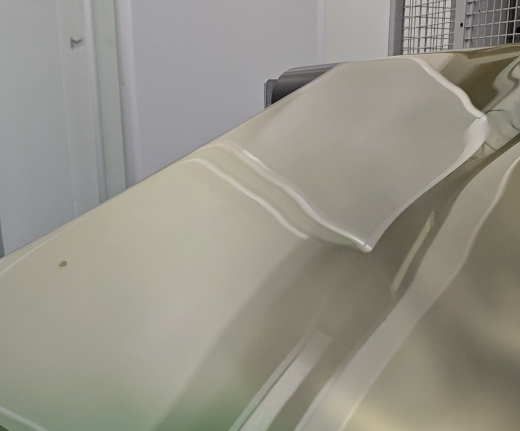
PEI film mounted against metal may bow, pull at a hole or shift its insulating coverage during a temperature cycle even when the loose film remains intact. The assembly constrains materials that may change dimensions differently as they heat and cool. Selecting by a heat-resistance description alone leaves that movement unresolved. The engineer needs to decide where the film may move and where it must remain fixed.
Dafu, an engineering plastic film manufacturer, lists DFPEI in natural and black versions with polished, matte and velvet texture options. The page describes dimensional stability and electrical insulation. These properties support considering PEI for a heated electrical assembly, but they do not mean zero expansion or guarantee compatibility with every metal mounting arrangement.
Define the constrained length
Begin with the distance between features that actually prevent movement. The overall film length may be less important than the span between two fasteners or bonded regions. Mark those fixed locations and the free edges on the drawing. A long strip held at both ends is a different mechanical situation from a similar strip located at one point and allowed to slide elsewhere.
Identify the metal material and the temperature that each part experiences. The film and housing may not reach the same temperature at the same time, particularly near a heat source. For an initial engineering assessment, obtain their relevant expansion data over the intended range and compare the expected movement over the constrained span. Do not insert a generic PEI coefficient when the selected film's directional data has not been supplied.
Separate reversible movement from permanent change
Measure the assembly at its initial reference temperature, during the thermal exposure where feasible, and after it returns to the reference condition. Movement that reverses on cooling differs from a permanent dimensional change. Photograph the same locations at each stage and identify whether the film bows, the mounting hole moves, an adhesive edge lifts or the metal fixture itself changes position.
Inspect a loose PEI control through the same temperature route. If the loose film changes permanently, its processing or conditioning history requires review. If the loose control remains dimensionally consistent while the mounted film distorts, restraint or interaction with the mounting materials becomes a stronger candidate. This comparison helps avoid describing every assembled distortion as film shrinkage.
Look for load transfer around holes and edges
A fixed fastener can turn differential movement into local strain around a hole. Examine the bearing edge, washer contact and nearby narrow sections after cycling. A photograph of the broad panel may miss damage at the small region carrying the load. Use the drawing to identify where the thermal movement is transferred into the film, then inspect those regions specifically.
If the film bows between attachments, check whether the original layout leaves room for it to move without contacting another component. Buckling can change electrical coverage even without tearing the material. Conversely, pulling tightly against an edge can reduce an overlap. The functional consequence depends on the assembly, so the acceptance limit should describe the required coverage or clearance rather than an arbitrary cosmetic flatness preference.
Evaluate mounting changes with electrical coverage
A floating location, revised slot or changed attachment span may be considered to accommodate movement. These are design options for the equipment team to assess, not automatic corrections. A slot that relieves stress must not let the barrier move away from the surface it protects. Define the permitted movement and the remaining coverage at the most unfavorable position before accepting a revised mounting layout.
Where adhesive supplies restraint, map its actual coverage and thickness. A continuous bond creates a different condition from isolated attachment patches. Its temperature response and holding behavior can influence the film's movement. Qualify the adhesive on the selected PEI finish and metal surface. The film's dimensional stability does not establish that an added bond will transfer or relieve thermal movement as intended.
PEI film direction belongs in the assembly record
Maintain machine and transverse identification on cut components when investigating directional behavior. Request expansion or dimensional-change data for the relevant direction and conditions. A scalar material description can be insufficient for a part with a long constrained axis. Keeping direction traceable also helps the converter reproduce the approved part instead of rotating a nesting layout without considering the design requirement.
Compare natural and black grades, or different finishes, only through the evidence applicable to those supplied products. Do not assume that color or texture is the only difference between commercial specifications. If a sample has been approved, retain its material identity, thickness and conversion orientation alongside the mounting drawing. This keeps the approved geometry connected to the material that was actually evaluated.
Use the relevant cycle and installation sequence
Define the intended heating and cooling route, exposure duration and assembly restraint. Include installation at the specified initial temperature and any cure or bake step that occurs before service. A thermal cycle on a freely hanging film does not reproduce a barrier fixed to a housing. Likewise, a single heating exposure cannot answer a requirement concerned with repeated movement at a fastener.
After the agreed sequence, inspect the attachment regions and verify the required electrical separation on assembled samples. Record coverage, hole condition and bond movement together with the electrical result. This links a mechanical observation to the barrier's function. It also helps determine whether a failure calls for a new material, a changed cut shape or an improved mounting arrangement.
Request data for the joint, not just a temperature label
To discuss DFPEI with Dafu, send the metal specification, constrained-span drawing, film direction and temperature history. Add reference-temperature measurements before and after cycling, photographs at the fixed points and the allowable movement or overlap. Ask for material data matching the selected grade and thermal range. The useful decision is whether the proposed PEI and mounting system preserve the required insulation through movement, not whether a loose film can survive heat.